

Skip the boilerplate. Ship the product.
Auth, RBAC, validation, migrations and a full test suite, wired together and ready on day one. Clone it, run one command, start building features.
Running in minutes
One setup command, no manual wiring
Rules enforced in CI
Architecture boundaries can’t quietly erode
Your code, your rules
Plain source, no lock-in, no per-seat fees
Oxyide Forge repository summary
Modules
You’ve answered these questions before.
Every new backend means the same decisions, and the same week or two spent making them. Forge makes them once, makes them well, and documents why.
Authentication
Where should authentication live?
Where should authentication live? Building this from scratch for every project means repeating the same decisions, wiring, and review — before any product logic exists.
This concern is already implemented, structured, and verified in the release. You keep it and extend it.
The foundation, done properly.
Everything most backends need before the first line of product code, built to be read, reviewed and extended.
Authentication
Email and password sign-in with bcrypt hashing at cost 12. Short-lived JWT access tokens are paired with rotating refresh sessions that are stored only as hashes, carry an expiry and can be revoked.
Authorization
Roles, permissions and per-route guards, enforced on the server with deny-by-default behaviour and separate read and write codes.
Validation
Zod schemas at every API boundary. Unknown fields are rejected rather than ignored, and a failure comes back as a readable 400.
Database
PostgreSQL through Prisma: an explicit data model, versioned migrations, and transactional writes for the operations that span several tables.
Operations
Liveness and readiness endpoints that answer separately, structured request logging with a request id on every call, security headers, and throttling on the login endpoints.
Testing
Unit, integration and end-to-end suites across the API, the web client and the browser, alongside type checking, linting and schema validation.
A foundation with clear boundaries.
Application modules stay separate from shared concerns and infrastructure, making the foundation easier to understand and extend.
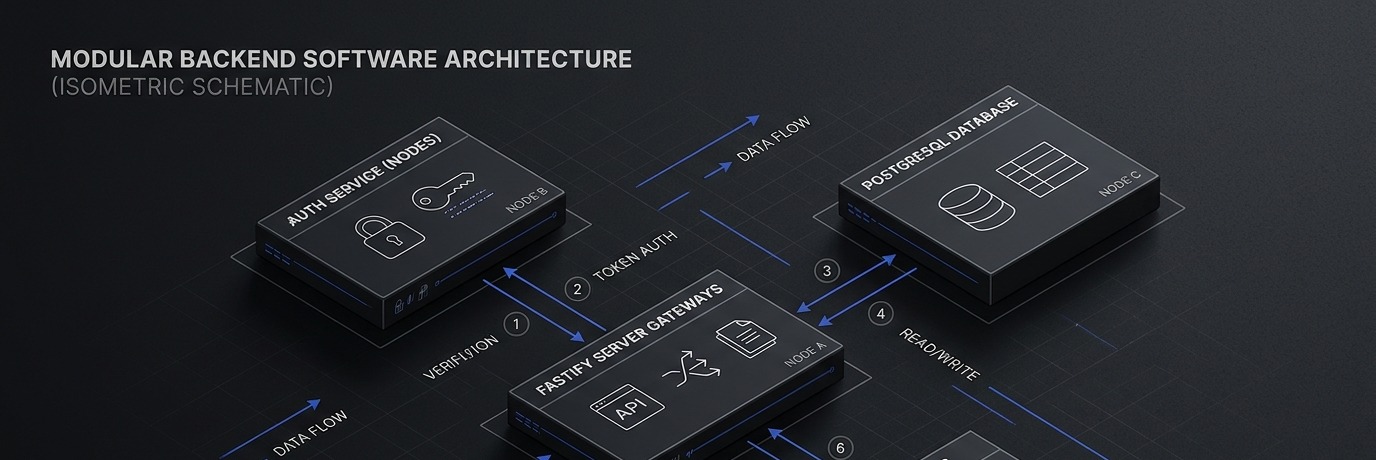
Know where your code belongs.
Application modules stay separate from shared concerns and infrastructure, making the foundation easier to understand and extend.
Explorer
OXYIDE-FORGE
59 folders · 332 files
app/
config/
src/app/server.ts
import type { FastifyInstance } from 'fastify';import { config } from '../config/index.js';import { installShutdownHandlers } from './lifecycle.js';export async function startServer(app: FastifyInstance): Promise<FastifyInstance> { const { host, port } = config; // … installShutdownHandlers(app); await app.listen({ host, port }); app.log.info({ host, port }, 'Fastify application started'); return app;}Weeks of groundwork, already in the repo.
Auth, permissions, data access and testing aren’t what makes your product special, but they have to be right. Here is what’s already built:
Authentication
JWT access tokens, rotating refresh sessions, bcrypt hashing, lockout
RBAC
Roles, permissions, route guards and ownership policies
Database + ORM
Prisma schema, additive migrations, repository boundary
API foundation
Application factory, versioned routes, OpenAPI contract
Validation & errors
Zod-validated configuration, strict request schemas, RFC7807
Testing foundation
Unit, integration, contract and architecture suites
Setup debt vs. product commits
Building the foundation (auth, sessions, migrations, route security, test harnesses) from scratch consumes weeks before any business logic is touched.
Do you want to spend weeks rebuilding this from scratch? Of course not — start building your product right now and skip the groundwork entirely.
Built around technologies you already know.
No exotic experiments or abandoned packages — selected for stability, speed, and widespread production adoption.
Built for people shipping real software.
Solo developers
Stop rebuilding the same setup. Start every new backend from a structure you already trust.
Startup teams
Get auth, permissions and testing out of the way and spend your first sprints on the product.
Freelancers and consultants
Start each client project from the same documented conventions, and ship the application without a per-seat licence.
One purchase. The foundation you keep.
Forge is a source-code foundation under a commercial license: modify it, build on it, and sell the applications you create. The Forge source itself is never resold, redistributed, or published.
Complete source release
The full Forge backend source: application modules, shared concerns, infrastructure wiring, configuration, and migrations.
Documentation and standards
Architecture documentation, authentication and authorization guides, database and migration notes, API conventions, and architecture decision records.
A tested starting point
The automated test foundation covering the functionality implemented in this release — extend it as your product grows.
One commercial license for one product. You may modify the source and sell the applications you build on it; read the license.
Purchase summary
v1.0.0Loading product…
Questions developers ask.
Answers about the product, the stack, the license and what is included.
Your first commit should be a feature, not a foundation.
Get Forge today and start with auth, structure, and tests already done — so you build the part only you can build.